
Table of Contents
Why Google Alone Is No Longer Enough
AI SEO for businesses India is no longer optional — 60% of mobile Google searches now end without a single click, and AI-generated answers are replacing traditional search results.
At Tecocea, an AI-powered digital marketing agency based in Zirakpur, India (MSME: UDYAM-PB-20-006595), we help businesses across India, New Zealand, and France appear not just on Google — but inside the AI-generated answers that millions of people are reading on ChatGPT, Perplexity, and Google AI Overviews every single day.
This guide explains exactly what AI SEO is, how it works in 2026, and what Indian businesses need to do right now to stay visible — before their competitors figure it out first.
What Is AI SEO? (And How It Differs from Traditional SEO)
“Understanding AI SEO for businesses India is the first step — and it starts with knowing how this differs from traditional SEO.”
AI SEO — also called Generative Engine Optimisation (GEO), Large Language Model Optimisation (LLMO), or Answer Engine Optimisation (AEO) — goes one step further. It is the practice of optimising your content so that AI systems like ChatGPT, Perplexity, Google AI Overviews, and Microsoft Copilot cite your business, recommend your services, or reference your expertise when answering user questions.
The difference matters because user behavior is changing rapidly | AI SEO for businesses India
| Factor | Traditional SEO | AI SEO / LLMO |
|---|---|---|
| Goal | Rank on Google Page 1 | Get cited in AI-generated answers |
| Platform | Google Search | ChatGPT, Perplexity, Google AI Overview |
| Content Type | Keyword-optimised pages | Authoritative, structured, entity-rich content |
| Metric | Position, CTR, traffic | Citations, brand mentions, AI referrals |
| Timeline | 3–6 months | 4–12 weeks for early citation |
| Competition in India | Very high | Near zero — massive first-mover opportunity |
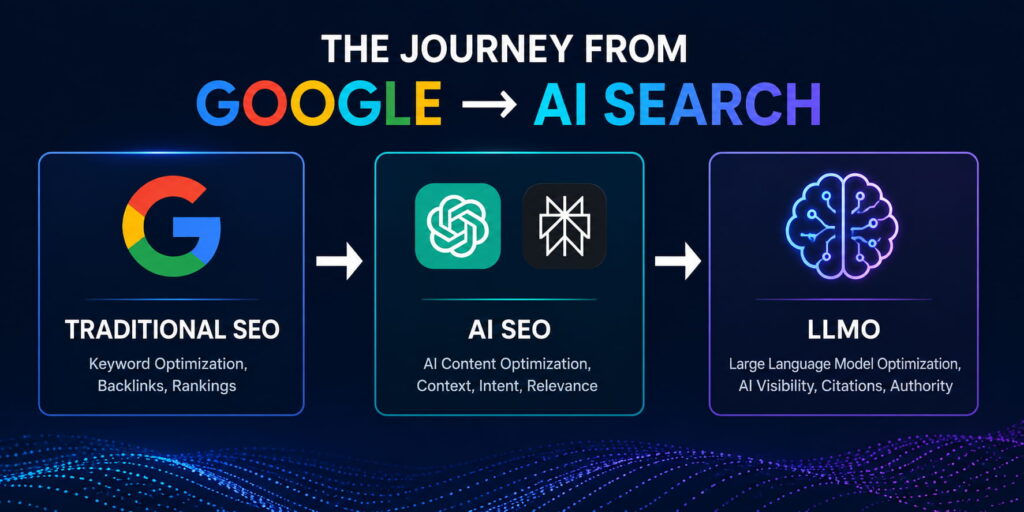
Indian businesses that start AI SEO today are where smart businesses were with Google SEO in 2008 — early enough to dominate before the crowd arrives.
How AI Search Engines Actually Work
To optimise for AI, you first need to understand how AI search engines generate their answers. There are two primary mechanisms:
1. Training Data (What the Model Already Knows)
Large language models like ChatGPT and Claude are trained on enormous datasets scraped from the internet — articles, websites, forums, academic papers, and more. If your business, expertise, or content appeared in this training data, the model may already “know” about you.
The challenge: training data has a cutoff date. Models are not updated in real time. This means stale or thin content from your website may not represent your current expertise accurately. AI SEO for businesses India can really improve from this.
2. Live Retrieval via RAG (Real-Time Information)
Retrieval-Augmented Generation (RAG) is the technology that allows AI systems like Perplexity and Google AI Overviews to search the live web and pull current information into their answers. When someone asks Perplexity “best digital marketing agency in Chandigarh,” it searches the web in real time, reads the top results, and synthesises an answer — citing its sources.
This is where AI SEO becomes immediately actionable: if your content is well-structured, authoritative, and recently published, the AI will find it, read it, and potentially cite it — even if you are a small business and this way AI SEO for businesses India guide becomes really helpful. Read till the end.
3. Entity Recognition
AI systems do not just read words — they understand entities. An entity is a person, place, organisation, or concept that the AI can identify and connect to other information. When your business name, founder name, location, certifications, and services appear consistently across your website, GMB, Clutch profile, and social media — the AI starts to recognise Tecocea (or your business) as a real, trustworthy entity in its knowledge graph.
This is why consistency of information across platforms is not just good practice — it is the foundation of AI SEO. Keep reading to understand AI SEO for businesses India
7 AI SEO Strategies That Actually Work in 2026 for AI SEO for businesses India
Strategy 1: Topic Clustering — Pillar and Cluster Content Model
A pillar article is a comprehensive, long-form piece of content (like this one) that covers a broad topic in depth. Cluster articles are shorter, focused pieces that cover specific sub-topics and link back to the pillar.
Topic clustering works for AI SEO because AI systems reward topical authority. If your website has 8 articles all covering aspects of digital marketing for coaching institutes in India — all linking to each other — the AI recognises your website as a genuine authority on that topic, not a thin site with one page.
For Tecocea, the pillar is this article on AI SEO. The clusters are articles on LLMO, GMB optimisation for coaching institutes, Meta Ads for education, and Google Ads vs Meta Ads for Indian businesses. Each cluster links back to this page. Each page strengthens the overall authority signal. We help AI SEO for businesses India
Strategy 2: Conversational Content Optimisation for AI SEO for businesses India
Traditional SEO targets short keywords: “digital marketing agency India.” AI SEO targets conversational questions — the way real people actually speak to AI: “What is the best digital marketing agency for coaching institutes in Punjab?” or “How do I get more student enquiries using Facebook ads?”
Write your content the way your clients talk, not the way search engines used to rank. Include natural language questions and direct answers throughout your articles. Each heading in this article is written as a question or a direct statement — because that is exactly how AI systems extract and present information.
Strategy 3: Schema Markup for AI Extraction
Schema markup is structured data code added to your website that helps search engines and AI systems understand the context of your content. The most important schema types for AI SEO for businesses India are:
- FAQPage schema — tells AI exactly which questions your content answers and what the answers are
- Article schema with author name, date published, and organisation — establishes E-E-A-T signals
- LocalBusiness schema — connects your business to a geographic location, critical for local AI search
- Organization schema — establishes your business as a recognised entity with name, URL, logo, and contact
Adding FAQ schema to your pages is the single highest-impact technical change for Google AI Overview inclusion. It takes 20 minutes and can result in your content appearing in AI answers within days. Keep reading AI SEO for businesses India – the most elaborative guide
Strategy 4: E-E-A-T Signals — Experience, Expertise, Authority, Trust
Google introduced E-E-A-T (Experience, Expertise, Authoritativeness, Trustworthiness) as a quality signal for both traditional and AI search. AI systems have adopted similar criteria when deciding whose content to cite.
For AI SEO for businesses India , building E-E-A-T means:
- Publishing content under a real author name with credentials (not “Admin”)
- Displaying certifications prominently — Google Certified, AI Certified, MSME registered
- Earning third-party reviews on Clutch, Google Maps, and JustDial
- Citing real case studies with specific, verifiable numbers — not vague claims
- Consistently updating content to reflect the most current information
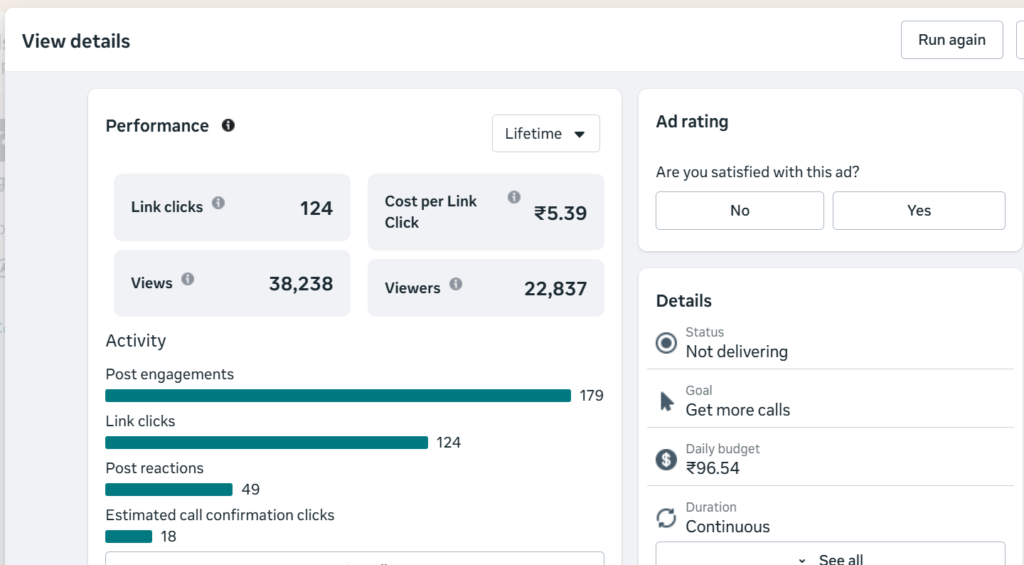
At Tecocea, our Google Certification, AI Certification, MSME registration, and verified Clutch review from a coaching institute client (38,238 views, Rs.5.39 CPC, 18 direct call confirmations on Rs.768 spend) are all E-E-A-T signals that AI systems weigh when deciding whether to cite our content.
Strategy 5: Entity-Based SEO — Brand Consistency Across Platforms
Entity-based SEO means ensuring that your business name, address, phone number, founder name, certifications, and services appear identically and consistently across every platform where you have a presence — Google Business Profile, website, Clutch, JustDial, LinkedIn, Instagram, and Facebook.
When an AI system searches for information about your business and finds identical, consistent information across 8+ platforms, it gains confidence that your business is a real, established entity. Inconsistent information — different phone numbers, different addresses, different business names — creates entity confusion and reduces citation probability.
For AI SEO for businesses India’s consistency, this means: your GMB name, website name, JustDial listing, and Facebook page should all show the exact same business name, address, and phone number. No abbreviations, no variations.
Strategy 6: Structured FAQ Pages
Frequently Asked Questions pages are among the most cited content types by AI systems. This is because AI systems are designed to answer questions — and FAQ pages provide pre-formatted question-answer pairs that are trivially easy for AI to extract and present.
Every service page on your website should include a FAQ section with 5-8 questions that your target clients actually ask. These should be written in natural language, answered concisely in 50-100 words per answer, and marked up with FAQPage schema.
For a coaching institute: “What subjects are taught in Class 11 Non-Medical?” or “What is the fee for NEET coaching in Pinjore?” For Tecocea: “How long does AI SEO take to show results?” or “What is LLMO and how does it differ from SEO?” Keep reading AI SEO for businesses India – guide
Strategy 7: LLMO — Optimising for Large Language Model Citations
LLMO (Large Language Model Optimisation) is the most advanced and least competitive frontier of AI SEO in India today. While traditional SEO has millions of practitioners competing for the same Google rankings, LLMO has almost no competition — especially in the Indian market.
LLMO involves specifically optimising your content to be cited by ChatGPT, Claude, Gemini, and Perplexity when users ask questions in your area of expertise. The key tactics are:
- Write definitive, authoritative answers to the most important questions in your industry
- Use clear, unambiguous language — AI systems prefer content that makes confident, specific claims
- Include verifiable statistics, case studies, and named examples
- Ensure your website allows AI crawlers (OAI-SearchBot, PerplexityBot, ClaudeBot) in your robots.txt
- Build citation mentions on third-party platforms — every time another website references your business, it strengthens your AI citation profile
Tecocea currently offers LLMO as a standalone service for AI SEO for businesses India — one of the very few agencies in India doing so at the time of writing.
AI SEO for Businesses India — What Makes the Indian Market Different?
India presents a unique and extraordinary opportunity for AI SEO adoption. Here is why:
The gap is enormous. While businesses in the US and UK have been experimenting with AI search optimisation since 2023, the vast majority of Indian SMBs — coaching institutes, clinics, real estate agents, D2C brands — have not even begun traditional SEO, let alone AI SEO. The businesses that start now will own this space for years.
Voice search is accelerating it. India has one of the highest rates of voice search usage globally — largely driven by Hindi and regional language speakers who find typing inconvenient. Voice searches are inherently conversational and question-based, which means they go directly to AI-powered answers rather than traditional search results.
Local AI search is emerging. Searches like “coaching institute near me for NEET in Pinjore” or “best digital marketing agency in Chandigarh” are increasingly being answered by AI Overviews on Google — pulling from the GMB profiles, websites, and third-party reviews of local businesses. A well-optimised GMB combined with AI SEO on the website creates a compounding local visibility advantage.
Case study — Tecocea in action: For one of our coaching institute clients in Punjab, a combination of GMB optimisation and targeted Meta Ads generated 38,238 views, 124 clicks, and 18 direct call confirmations in 7 days on Rs.768 total ad spend — a CPC of Rs.5.39 against an industry average of Rs.15-25. The same content and GMB optimisation principles used in that campaign are the foundation of the AI SEO for businesses India and the approach we apply for all clients.
Tecocea (Google Certified, AI Certified, MSME: UDYAM-PB-20-006595) is based in Zirakpur, Punjab and serves coaching institutes, clinics, real estate businesses, and D2C brands across India, New Zealand, and France with AI-first digital marketing strategies.
How to Implement AI SEO for Your Business — Step by Step
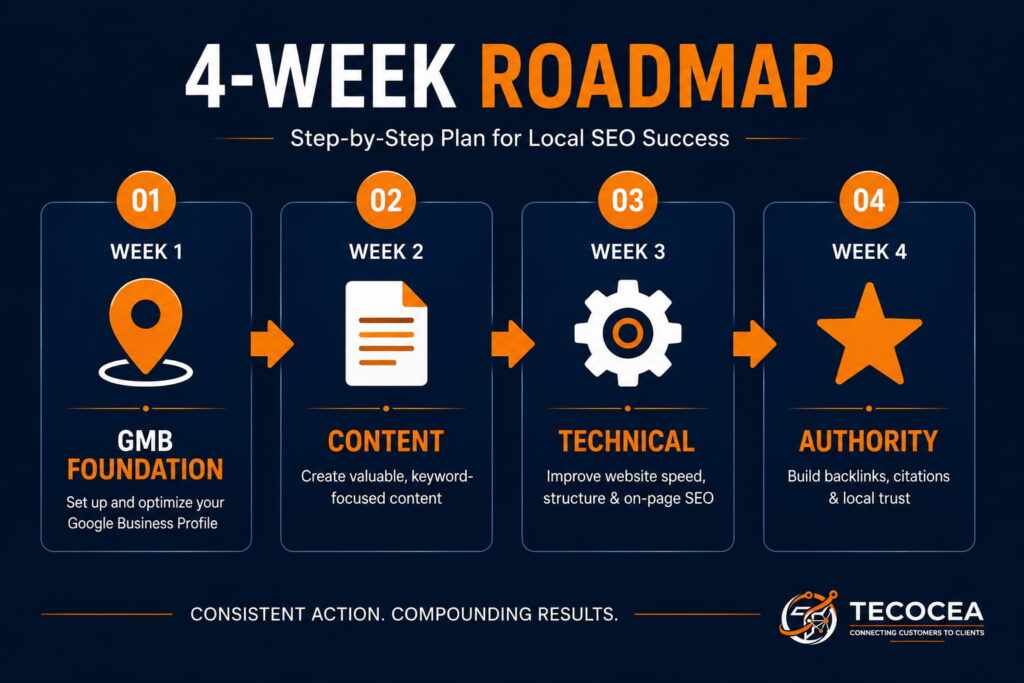
Starting AI SEO does not require a large budget or technical expertise. Here is a practical implementation sequence for Indian SMBs:
Week 1 — Foundation Ensure your Google Business Profile is fully completed — every section, every photo, every service listed. Add your website URL, phone number, and business description with local keywords. Respond to every existing review. This is your most important local AI SEO signal.
Week 2 — Content Write one pillar article on your primary expertise area. For a coaching institute: “Complete Guide to NEET Preparation for Class 11 Students in Punjab.” For a clinic: “When Should You See a Dermatologist — A Complete Guide for Indian Patients.” Make it genuinely useful, 1,500+ words, and include a FAQ section.
Week 3 — Technical Add FAQPage schema to your main service pages and pillar article. Update your robots.txt to allow AI crawlers. Submit all new URLs to Google Search Console for indexing.
Week 4 — Authority Request reviews on Google Maps from every satisfied client. Get listed on Clutch if you are a service business. Add your business to JustDial and IndiaMart with consistent NAP (Name, Address, Phone) information. Each listing strengthens your entity recognition.
Month 2 onwards Write cluster articles linking to your pillar. Post on LinkedIn and Instagram consistently. Monitor Google Search Console for impression growth. Watch for AI Overview appearances by searching your key questions in Google and noting whether your content appears.
FAQ — Everything Businesses Ask About AI SEO
What is AI SEO for businesses India and how is it different from regular SEO? AI SEO (also called LLMO or GEO) is the practice of optimising your content to appear in AI-generated answers on platforms like ChatGPT, Perplexity, and Google AI Overviews — not just on traditional Google search results pages. Regular SEO targets the ten blue links. AI SEO targets the AI-written answers that appear above them.
How long does AI SEO take to show results? Unlike traditional SEO which typically takes 3-6 months, AI SEO can show early results in 4-12 weeks — particularly for Google AI Overviews, which pull from live web content. LLMO citation in systems like ChatGPT takes longer as it depends on training data cycles.
Can small businesses and coaching institutes do AI SEO? Yes — and small businesses have an advantage right now because competition is near zero in most Indian niches. A coaching institute in Pinjore that publishes one authoritative article about NEET preparation in Haryana faces almost no competition for AI citations on that specific topic.
What is LLMO? LLMO stands for Large Language Model Optimisation. It is the practice of structuring your content, business information, and online presence so that large language models like ChatGPT, Gemini, Claude, and Perplexity cite your business when answering questions in your area of expertise. It is the next evolution beyond traditional SEO.
How do I get my business to appear in ChatGPT answers? Ensure your website allows OAI-SearchBot in robots.txt. Publish authoritative, well-structured content that answers specific questions in your industry. Build consistent entity signals across platforms — same business name, address, and phone everywhere. Earn third-party citations — reviews, directory listings, press mentions. Create FAQ pages with schema markup.
Does Google AI Overview affect my website traffic? Yes — Google AI Overviews can reduce clicks to your website if they answer the user’s question without needing them to visit. However, businesses that are cited within the AI Overview actually gain significant trust and brand visibility — and typically see enquiries from higher-intent prospects who already trust them based on the AI recommendation.
How much does AI SEO cost in India? At Tecocea, AI SEO and LLMO services start at Rs.8,000 per month for Indian businesses, making it accessible to coaching institutes, clinics, and SMBs that want a genuine competitive advantage in AI search before their competitors catch on.
What is the difference between GEO and SEO? SEO (Search Engine Optimisation) targets Google and Bing search results. GEO (Generative Engine Optimisation) targets AI-generated answer engines — ChatGPT, Perplexity, Google AI Overviews. GEO is the evolution of SEO for the AI era. Both are important in 2026; businesses that do only one are leaving visibility on the table.
Get a Free AI SEO Audit for Your Business
Most Indian businesses are completely invisible in AI search — not because their services are poor, but because their online presence has not been optimised for how people are searching in 2026.
AI SEO for businesses India is still in its early stages — which means the businesses that act now will dominate AI search results for years.”
Tecocea offers a free 15-minute AI SEO audit for businesses in India, New Zealand, and France. We will show you exactly where you are missing AI search visibility and what to do about it — with specific, actionable recommendations you can implement immediately.
Book via WhatsApp: wa.me/919877504794
Or visit: tecocea.com/contact-us
Served by: Arsh Dixit, Founder — Google Certified, AI Certified
Based in: Zirakpur, India (Serving Global Clients)

Name: Arsh Dixit
Founder – Tecocea
Google Certified | AI Certified | MSME Registered
“Arsh Dixit is the founder of Tecocea, an AI-powered digital marketing agency based in Zirakpur, India. He specialises in AI SEO, Meta Ads, and LLMO for coaching institutes and SMBs across India, New Zealand, and France.”
Pingback: GMB Optimisation for Coaching Institutes India — Complete Guide
Pingback: Google Ads vs Meta Ads for Coaching Institutes — Which Works Better in 2026? - Tecocea — Stop Losing Leads | AI Marketing Agency